With so many great addiction and mental health books for recovery, it’s difficult to find the best ones that fit each reader’s wants and needs.
Just as each person’s substance use and mental health recovery journey are unique, so are the tools and treatment approaches they respond to when healing.
Recovery books are a valuable resource that informs, educates, soothes, and offers practical tools for individuals in recovery, their families, and the treatment professionals who care for them.
It’s easy to find a list of substance use or mental health books about a single topic like drug addiction or depression treatment just by doing an online search. But recovery is a complex experience that requires a holistic understanding of many healing elements other than just treating the symptoms.
The books listed below offer different but complementary ways to understand the brain, heal the body, and build a more stable and joyful life in recovery.
Instead of simply covering addiction or mental health conditions, they address a wider range of topics like the biology of addiction, the impact of trauma, the power of neuroplasticity, the role of society, and daily practices that support long-term change.
Recovery Books About Addiction and the Brain
Understanding how substances affect the brain helps people see addiction less as a moral failing and more as a chronic, treatable brain condition. These books about addiction discuss the science and history of addiction at multiple levels – from individual neurobiology to national drug policy.
These addiction books can help people in recovery, their families, and therapists examine addiction from the perspective of vulnerability, environment, and connection rather than willpower alone.
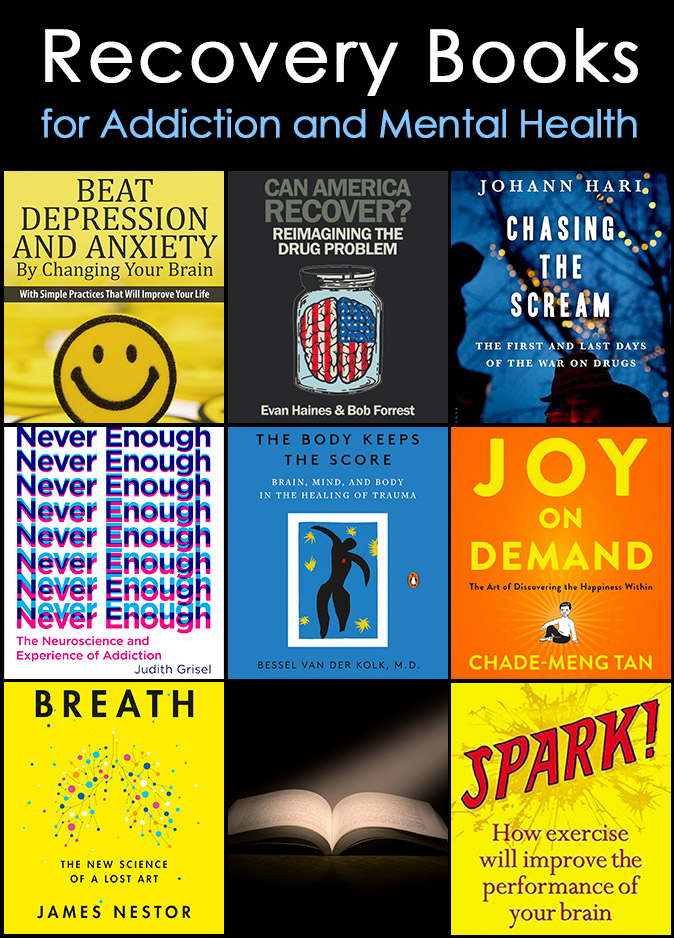
Never Enough: The Neuroscience and Experience of Addiction
By Judith Grisel
Judith Grisel explains through her up close and personal experiences as a former substance user turned behavioral neuroscientist how different drugs change the reward and learning pathways in the brain, and why tolerance makes “just one more” never feel like enough.
Her long struggle with addiction that began with her first drink at 13 years old led her to a Ph.D. in neuroscience to better understand her condition and help others.
Every chapter of Never Enough focuses on a different substance and how each one affects the brain and addiction. Chapters include THC, opiates, alcohol, tranquilizers, stimulants, psychedelics, and others.
The book offers insights for both treatment professionals and those in recovery and helps makes sense of the intense temptation of substance use.
It discusses why early recovery is so difficult and reinforces the need for compassion, connection, long‑term support, and lifestyle changes rather than quick fixes.
Can America Recover? Reimagining the Drug Problem
By Evan Haines and Bob Forrest
Dr. Evan Haines and musician Bob Forrest provide a deep examination into the historical, cultural, and spiritual aspects of addiction and mental health treatment.
As co-founders of the award-winning dual diagnosis facility, Oro House Recovery Centers, they offer unique perspectives of addiction and treatment.
Can America Recover traces the mistreatment of mental health and substance abuse back to 16th century asylums and explores the journey to modern day practices and topics like the War on Drugs with a critique on current punitive practices.
The book centers on reimagining addiction as a public health and human problem rather than a criminal or moral one by challenging the idea that addiction is solely caused by an individual’s struggles.
This is part of a broader cultural theme about society’s fragmentation and personal isolation. True recovery requires societal change.
America can recover by reimagining its approach to the drug problem through compassion, connection, community, dignity, and spiritually grounded evidence-based care that are foundational to the core success of Oro House.
Chasing the Scream: The First and Last Days of the War on Drugs
By Johann Hari
British journalist and author Johann Hari examines the history of the war on drugs and discusses how criminalization has led to violence, incarceration, and stigma without reducing rates of substance use or addiction.
Hari tracks the international drug war back to its roots in America that began with Harry Anslinger’s criminalization of marijuana and other drugs. From there, the policies spread across the globe.
Much like Can America Recover, Hari ties addiction to isolation, societal issues, and trauma. He uses the “rat pack” psychological experiments in the 1970s to validate his beliefs about the true nature of addiction and isolation.
Hari wrote, “The opposite of addiction is not sobriety. The opposite of addiction is connection.”
He explores programs and countries that reduced addiction and crime rates through compassion, connection, and decriminalization.
Chasing the Scream strongly advocates for treating addiction as a health and social issue rather than a criminal or moral failing to reduce the stigma and motivate more people to seek treatment.
Mental Health Books About Trauma, Mood, and Neuroplasticity
Many people develop mental health disorders in the aftermath of trauma, chronic stress, or substance use addiction.
These mental health books connect the dots between lived experience, brain changes, and practical, body‑based tools for healing.
They are especially helpful for readers who feel stuck in patterns of fear, numbness, or depression and want to understand how recovery can literally reshape the brain over time.
The Body Keeps the Score: Brain, Mind, and Body in the Healing of Trauma
By Bessel van der Kolk, M.D.
The Body Keeps the Score is a highly regarded book that changed the way many mental health professionals view and treat trauma.
Van der Kolk applies years of practical clinical experience and research to explain how traumatic experiences hijack the amygdala and prefrontal cortex, which causes individuals to remain in a constant state of fight, flight, or freeze.
He observed that trauma affects emotions, memories, the immune system, and more importantly the body. This is why traditional treatment approaches like medications or psychotherapy might not be adequate for all individuals to recover.
In addition to the mental symptoms of trauma like learned helplessness, the body also communicates distress through physical sensations, chronic pain, and other somatic issues distinct from the mind.
He advocates for body-based movement and experiential treatment modalities such as yoga, EMDR, theater, neurofeedback, breathwork, and somatic therapies that engage the body as well as the brain, so patients regain a sense of safety.
The book addresses the mental health symptoms caused by trauma as well as why individuals self-medicate with drugs or alcohol to numb physical and emotional distress.
Beat Depression and Anxiety by Changing Your Brain
By Debbie Hampton
Debbie Hampton blends her personal experience of surviving a severe brain injury with an easy-to-understand explanation of the neuroscience behind why repeated habits reshape and heal the brain over time.
She explains why neuroplasticity allows the brain to rewire itself and how this can positively change its structure, function, and default thought patterns.
Beat Depression and Anxiety by Changing Your Brain outlines strategies like mindfulness, meditation, gratitude, movement, nutrition, and thought reframing, that gradually improve mood, and reduce anxiety, stress, and depression to complement therapy or medication.
With over 30 chapters, each being only three or four pages, it covers a wide range of mental health issues.
Each chapter offers a simple and straightforward explanation of a topic or condition, such as the Toxic Cycle of Stress, that points out the difference between eustress vs distress, or good stress and bad stress.
Most chapters include a list of 5 to 10 effective strategies for overcoming the topic of the chapter that readers can easily relate to and use for their own personal struggles.
Beat Depression and Anxiety is an excellent toolkit of strategies for mental health and addiction recovery that can be used every day to heal the brain.
Recovery Books About Everyday Practices for Joy and Calm
Recovery and mental health are not only about treating symptoms. They are also about learning to access moments of calm, joy, and presence in ordinary life.
These books offer practices that fit into a busy schedule and can be used to complement formal treatment.
They are particularly useful for people who feel intimidated by long meditation retreats or complex spiritual traditions but still want evidence‑based tools.
Joy on Demand: The Art of Discovering the Happiness Within
By Chade‑Meng Tan
For anyone struggling to incorporate meditation and mindfulness into their daily life, or those looking for new ways to practice it, Joy on Demand is a must read.
Chade-Meng Tan introduces fun and accessible mindfulness techniques that make joy available on demand.
As a Google engineer, Meng developed the company’s internal “Search Inside Yourself” mindfulness program for busy people.
His “one-breath meditation” is designed to rewire the brain for happiness with a single breath.
He uses humorous analogies and simple techniques that are easily mastered and can be done literally anywhere on a moment’s notice.
The brief and approachable exercises outlined in the book are ideal for anyone who is intimidated by trying to learn how to meditate.
Meditation and mindfulness are excellent tools for regulating emotions, reducing rumination, and overcoming the stress and anxiety associated with mental health and addiction recovery.
Breath: The New Science of a Lost Art
By James Nestor
Breathwork is an integral part of yoga, meditation, mindfulness, and techniques for improving mental, physical, and emotional well-being.
Journalist James Nestor presents the fascinating findings from his global journey to uncover the modern science and ancient traditions behind breathing.
It may come as a surprise that over the past thousand years or so, humans have stopped breathing properly.
Nestor explains that modern lifestyle routines, and even the food we eat, has caused a shift to chronic mouth breathing and rapid or shallow, unbalanced breaths that negatively affect our physical and emotional health.
The book begins with his own personal breathing experiment at Stanford University that shows how forced mouth breathing created problems with his heart rate, blood pressure, and sleep.
Throughout his exploration, Nestor meets with doctors, athletes, and scientists who study how breathing can improve mental and physical performance.
Breath provides practical exercises like shifting to nasal breathing, extended exhalation, and controlled breathing methods that balance and calm the stress response.
Because breathing is always available, learning proper techniques can regulate emotions, cravings, and improve physical well-being that is necessary for those in mental health and addiction recovery.
Books About Exercise and Movement as Medicine
Exercise is one of the most underused and powerful interventions for both mental health and addiction recovery. It affects many of the same neurotransmitters targeted by psychiatric medications and can help repair a stress‑damaged brain.
For people in or after treatment, movement can become a cornerstone routine that supports mood, sleep, cognitive function, and relapse prevention.
Spark: The Revolutionary New Science of Exercise and the Brain
By John J. Ratey, M.D.
Harvard Medical School psychiatrist John J. Ratey MD, distills complex scientific research about exercise and the brain into an easy to read and understand resource for improving physical and mental health.
He explains how regular physical activity optimizes the brain to improve mood, neuroplasticity, and cognitive health by increasing neurotransmitters, and brain-derived neurotrophic factor (BDNF) that grows new brain cells.
Each chapter of the book discusses the benefits of exercise for a specific mental health condition (anxiety, stress, depression, addiction) or life stage (aging, menopause).
It analyzes how different types of exercise affect the brain and why we should alternate between aerobic exercise, strength work, and high-intensity interval training (HIIT).
Exercise stimulates the same neural pathways and brain chemicals targeted by many prescription medications, except in a healthier, drug-free way.
Spark offers exercise guidelines for building weekly movement plans that are essential for people in recovery.
The best addiction and mental health books for recovery address ways of holistically healing the brain and body. The ones listed here are all excellent recovery books and we’ll add more in the future.