Join together with others across the nation to participate in The Great American Smokeout recognized every year on the third Thursday in November. This year it falls on Thursday, November 20, 2025.
Quitting smoking can be hard, but with support, tools, and a clear date in mind, it can be done. We firmly stand behind this event that has been helping people live smoke-free lives for 50 years.
Smoking remains a major health concern in the U.S. It’s also a burden to the economy both directly via medical costs, as well as a loss of productivity.
Recent data suggests smoking-related illnesses and health conditions lead to approximately $185 billion in lost productivity.
According to the CDC, nearly 20 of every 100 U.S. adults (19.8%), use tobacco products.
As many as 15% of young adults between 18 and 34 years of age report vaping or using e-cigarettes.
The U.S. Surgeon General says, “Smoking cessation [stopping smoking] represents the single most important step that smokers can take to enhance the length and quality of their lives.”
History of the Great American Smokeout
The Great American Smokeout began when Arthur P. Mullaney asked participants at a 1970’s event in Randolph, Massachusetts, to give up smoking for one day.
He requested they donate the money they would have spent on cigarettes to a high school scholarship fund.
This was followed up by the first D-Day (Don’t Smoke Day) in 1974.
A larger event two years later on November 18, 1976, was held by the California division of the American Cancer Society when almost 1 million people decided to quit smoking for a day.
This event began to turn the tides for smokers worldwide.
The first official nationwide Great American Smokeout was promoted by the American Cancer Society in 1977.
The Great American Smokeout has been held on the third Thursday of November for almost 50 years.
It is designed as an event to encourage people to consider making a plan to quit smoking tobacco, similar to World No Tobacco Day on May 31.
Death By Smoking
Although our perception of smoking has changed for the better, there’s still an alarming number of smokers in the United States.
Tobacco use and cigarette smoking is the leading cause of preventable disease, and almost half a million deaths per year in the United States. Smoking also leads to a shorter lifespan, with smokers dying 10 years younger on average.
With greater understanding, education and other legislation, people have changed their opinion about tobacco. We no longer allow it to be advertised in many places and the facts about the deadly truth of cigarette smoking are now out in the open.
A study published in JAMA showed that smoking accounts for 30% of all cancer deaths.
Secondhand Smoke (SHS)
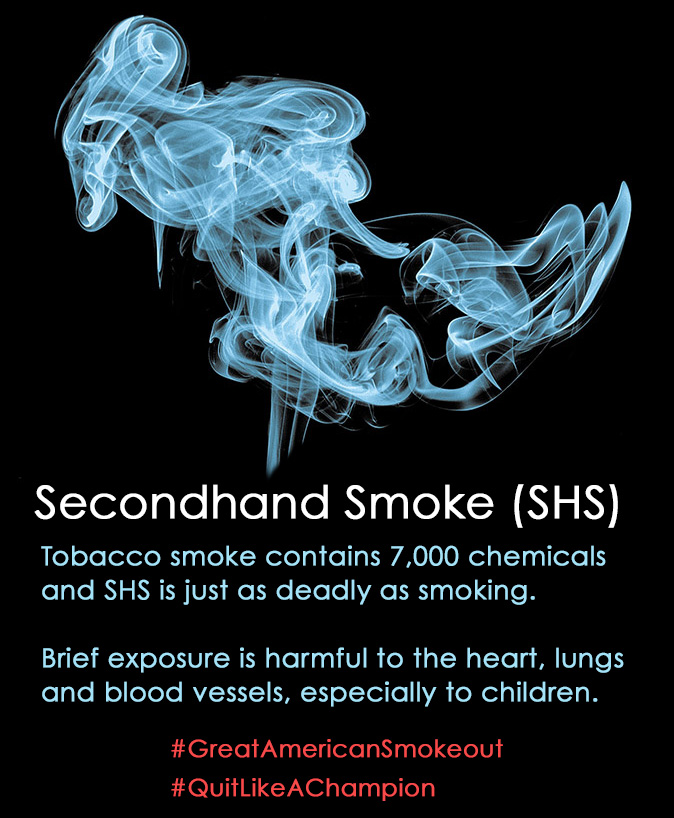
Smoking doesn’t just harm the smoker. Secondhand Smoke (SHS) is just as deadly as smoking. Secondhand Smoke is the smoke that is exhaled by smoking tobacco products. It’s sad to know that secondhand smoke used to go unchecked in both homes and workplaces.
Tobacco smoke contains 7,000 chemicals and even brief exposure is harmful to health. SHS affects the heart, lungs, and blood vessels, especially those of young children.
Due to awareness events like the Great American Smokeout, smoke exposure has declined from 90% of non-smokers having high levels of nicotine in their bodies in 1991, to 25% of nonsmokers who had measurable levels of nicotine in their bodies in 2012.
The change in social norms, reduction in smokers, and new legislation has played a major role in the reduced impact of second-hand smoke.
Changing Our Attitude Towards Smoking
There have been great advancements in our attitude towards smoking as a society over the past 50 years. This is due to initiatives like the Great American Smokeout.
This annually recognized event helps save lives and encourages local governments to put smoking bans and taxes in place. One example is the “Family Smoking Prevention and Tobacco Control Act,” which was implemented on June 22, 2009, and prohibited marketing tobacco products to children.
Back in the 80s, people still smoked in workplaces, restaurants, airplanes, and cars. This has all changed for the better today, thanks to events like The Great American Smokeout, that have raised awareness about the real dangers of smoking.
Quitting Nicotine
Smoking and vaping can be coping mechanisms often picked up in social situations.
Both the habit vs addiction to nicotine are powerful and notoriously hard to control.
Many people are more likely to be successful in stopping if they get help.
Asking for help and refraining from social situations that may trigger nicotine addiction and tobacco use are keys to successfully quitting vaping and cigarette or tobacco use.
Getting Involved With The Great American Smokeout
The Great American Smokeout has evolved and made great strides in battling both the perception of smoking and helping people quit.
Millions of volunteers take part in making the event memorable with non-smoking rallies, parades, support groups, and other public events.
Use the hashtags #GreatAmericanSmokeout and #QuitLikeAChampion on social media to encourage others to give up smoking for good.
Rally forces in the spirit of quitting by taking part in a local event and sharing your experiences online.